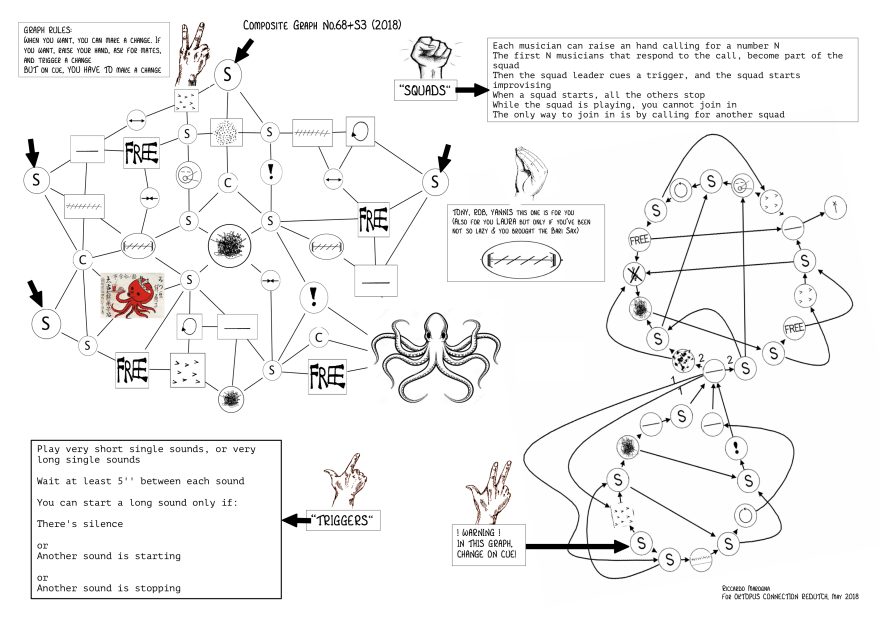
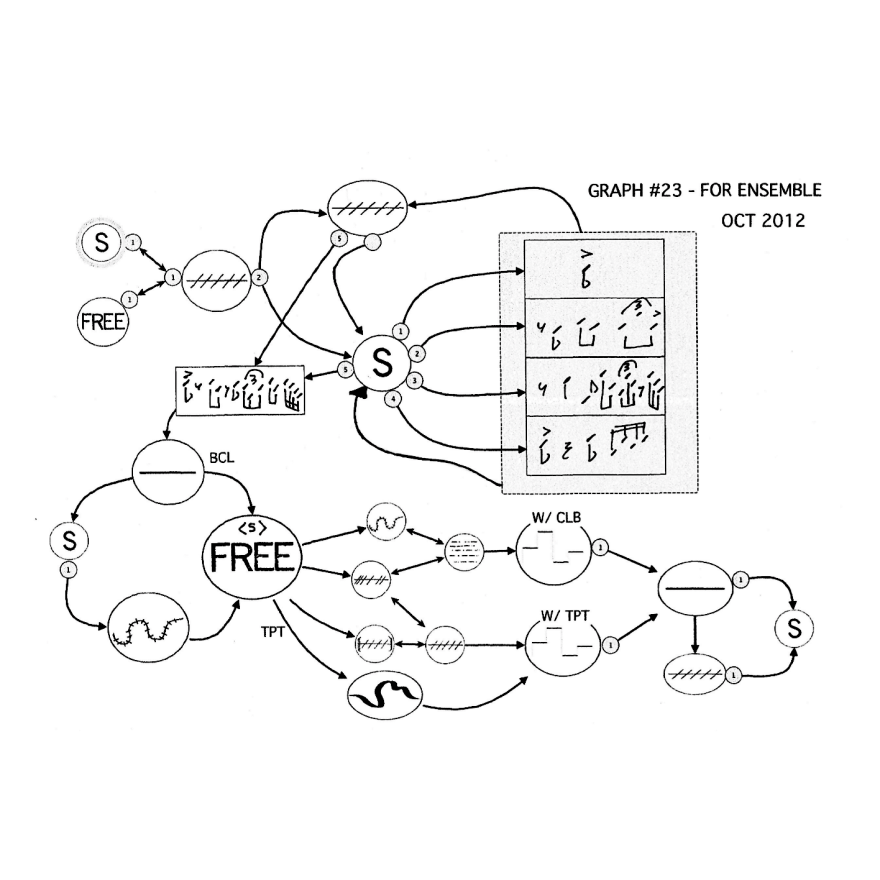
In my experience within the free improvisation context, I’ve found that graphic notation can be an useful tool for guiding the improvising musicians, defining macro-structures but leaving them with enough freedom to let them express their ideas and personalities. This experience led me to the definition of a graphic notation system for improvisation, called Graphograms. This notation is based on the graph theory and a parametric vocabulary, which guides the musicians through the improvisation process. The graphical score defines some “sonic states” in which the musician can stay, and the chance to make some transitions to other states. In this way, each musician has the possibility to make its own path through the graph, colliding and/or collaborating with the others. This results in a “quasi-stochastic” music, which can rapidly move from quiet, soft scenarios to full noisy bursts of energy and then turn again to some sort of obbligato passage which sounds as written music (but actually it’s not).
Graphograms vocabulary has been originally developed for the Oktopus Ensemble, an octet of improvisers based in Padova, Italy (published by Setola di Maiale Label, 2014, see: http://www.setoladimaiale.net/catalogue/view/SM2680 ). Throughout the years, I have been experimenting this kind of notation with different groups of improvisers, such as the Oktopus Connection ReDutch and the Oktopus Connection Ensemble.
 Riccardo Marogna