Research Project, Lectorate Music, Education, Society [2026]
https://researchplatform.art/people/riccardo-marogna
In the field of computer music, two major currents of thought have emerged over the past few decades. As Nikolas Valsamakis notes:
“ [Hoffman] called these two cultures as “disguised” and “explicit” computer music [..]. The disguised computer music, which is the majority trend, is interested in emulating aspects of music making practice within the established cultural framework. This trend tries to “humanize” the machine and produce “natural” and “beautiful” sound, terms that derive from the dominant western culture positivist concepts and aesthetics. […] The explicit computer music is interested in conceptualizing the use of machines and taking the technical means into account, […] experimenting with what is beyond the established culture in a radical approach”
This latter orientation is embedded in the DNA of the Institute of Sonology. Some of the earliest and most influential non-standard synthesis techniques were pioneered there by prominent figures such as Gottfried M. Koenig, Paul Berg, and S.R. Holtzman. During the mid 1970s, they explored computer-based algorithmic composition and sound generation, critically departing from traditional musically based descriptions (such as pitch, timbre, or acoustic parameters). Their work moved toward a more abstract, reductionist approach in which the digital machine is regarded as a sound-producing entity per se, and sound as a pure sequence of numbers shaped through mathematical and logical operations.
Building on this lineage, this one-year project is structured around three interconnected paths:
Historical Investigation
Conduct research in the Sonology archive and, where possible, by interviewing direct sources. As part of this process, port a historically significant sound-synthesis algorithm — Koenig’s SSP — into an open-source format within a contemporary digital framework.
Artistic and Technical Exploration
Taking inspiration form these historical examples, and my previous experiments with other non-standard techniques, explore a novel and critically informed approach to sound synthesis—one that extends beyond the well-trodden paths and engages with less-explored techniques.
Pedagogical Integration
Translate the acquired knowledge and newly developed tools into teaching practice, enhancing my course programs with perspectives rooted in explicit computer music and alternative synthesis paradigms.
Sonology Legacy: SSP and PILE
Aligned with the Lectorate’s theme of musical heritage, this research is rooted in the legacy of synthesis models developed at the Institute of Sonology since the 1970s, beginning with Koenig’s SSP program [1] and Berg’s PILE [2]. These works form part of a broader constellation of non-standard synthesis methods, which also includes approaches such as Xenakis’s Dynamic Stochastic Synthesis [3] and Brün’s SAWDUST [4].
More recently, Di Scipio [5] has expanded this lineage by proposing algorithms based on iterated functions. A comprehensive overview of these techniques is provided in [6]. Döbereiner [7] offers a contemporary perspective that integrates theoretical and philosophical reflections on this evolving field.
Numerous Sonology alumni have further contributed to the development and exploration of non-standard synthesis, including Sergio Luque, Stelios Manousakis, and Jeyong Jun, among others. Additionally, Bjarni Gunnarsson et al.[8] have conducted research on G. M. Koenig’s Project 2 program for algorithmic composition.
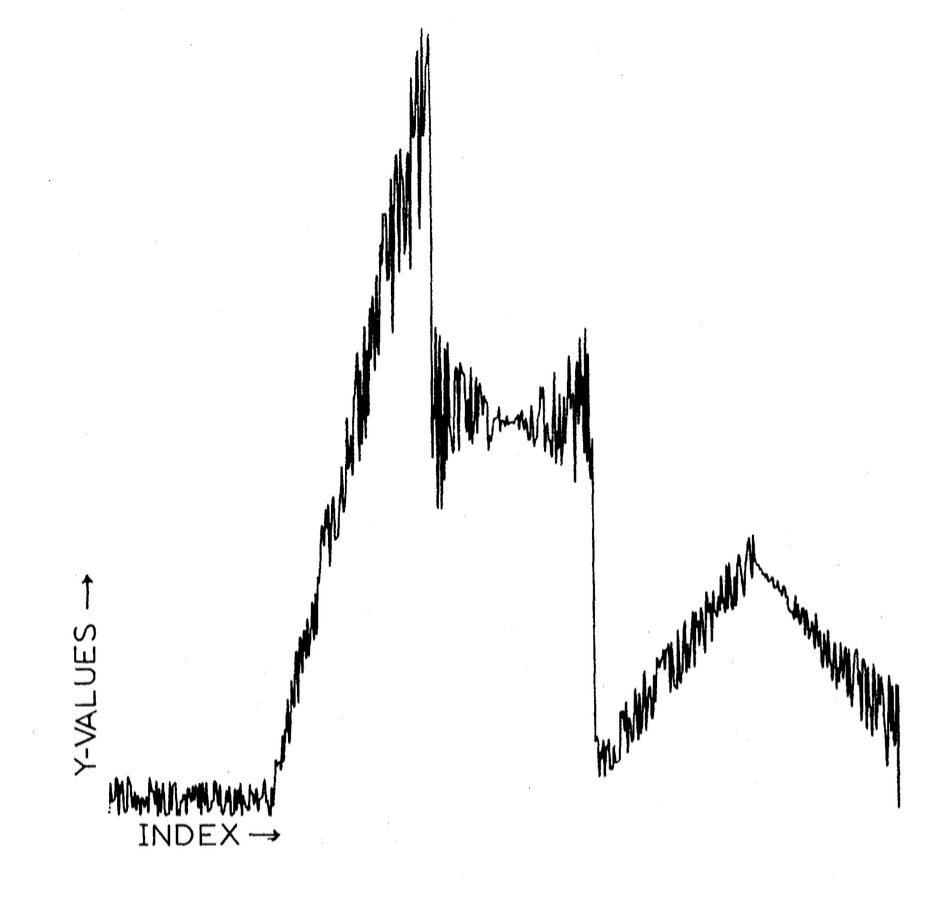
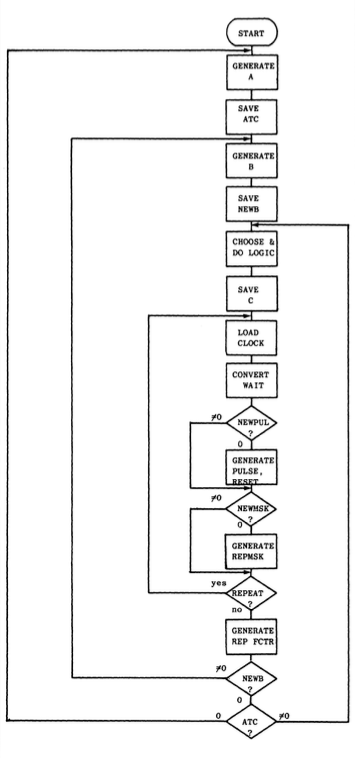
How can we draw inspiration from this legacy to explore novel, non-standard sound synthesis techniques?
My own engagement with non-standard synthesis originates in physically-informed sound synthesis — a topic I have worked on extensively over the years. I gradually extended my interests toward synthesis algorithms based on abstract dynamical systems, iterative maps, and recurrent sequences. These techniques are particularly compelling because they demonstrate how complex, emergent sonic behaviour can arise from simple mathematical rules.
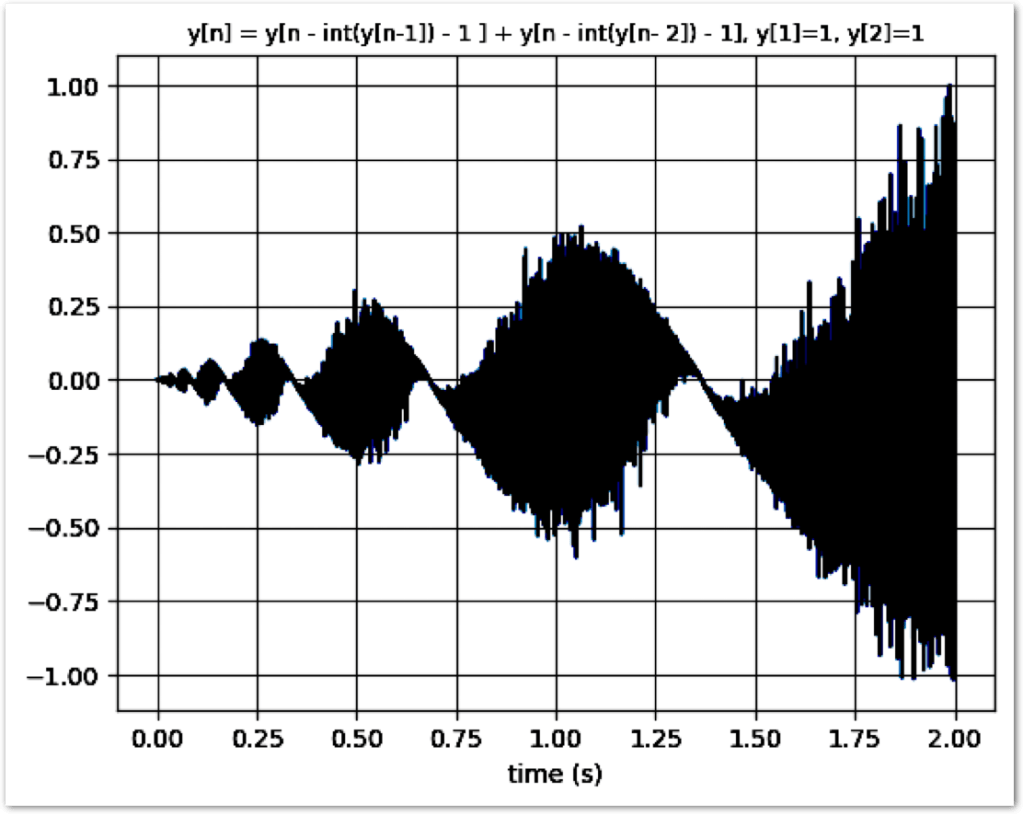
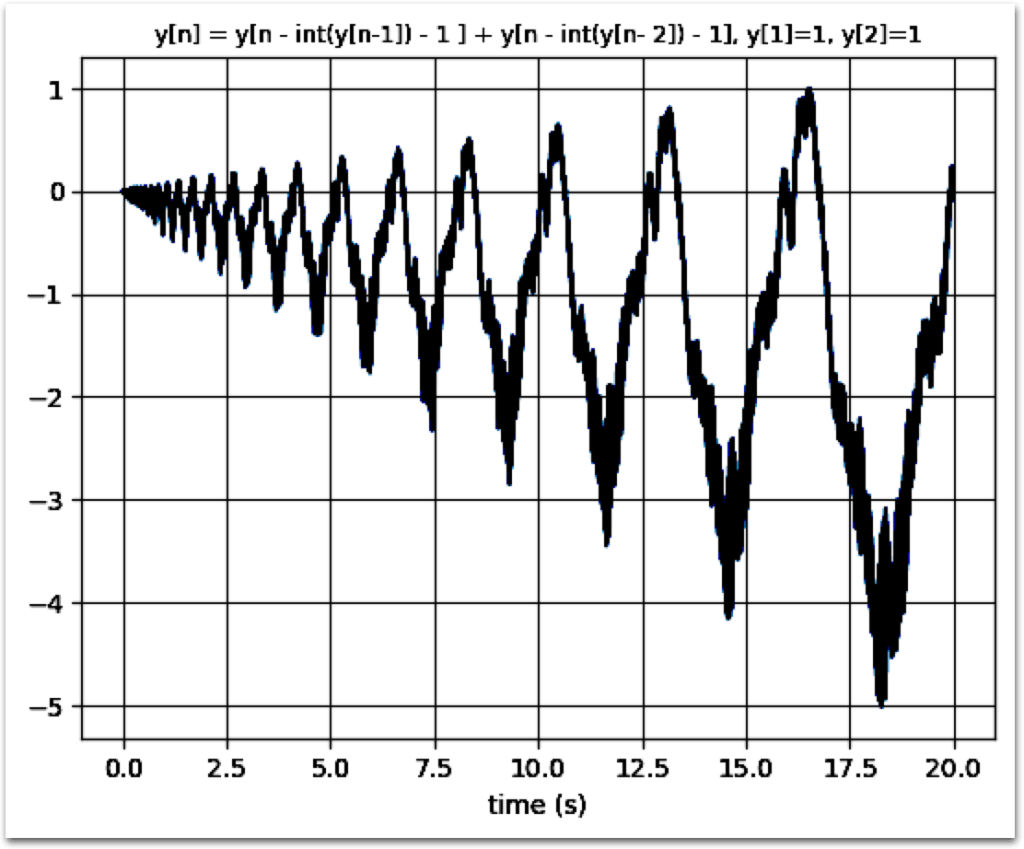
Sound signals synthesized using recursive sequences, inspired by Wolfram’s work.
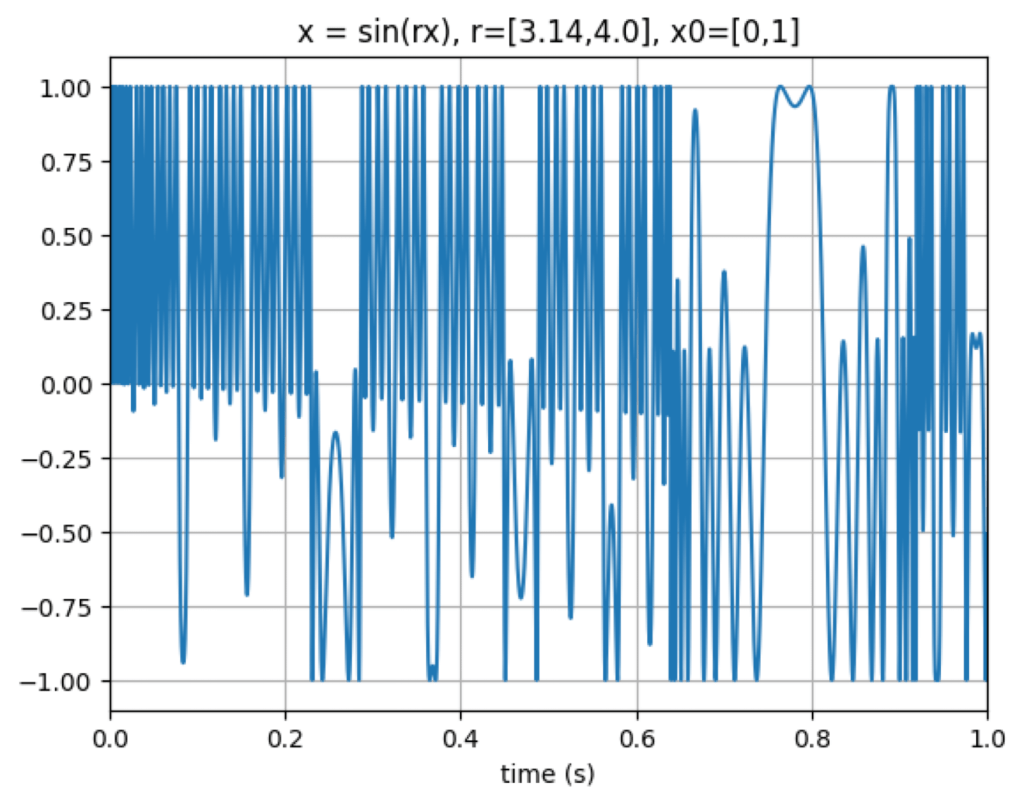
Sound signal synthesized by iterated functions, after Di Scipio [7]
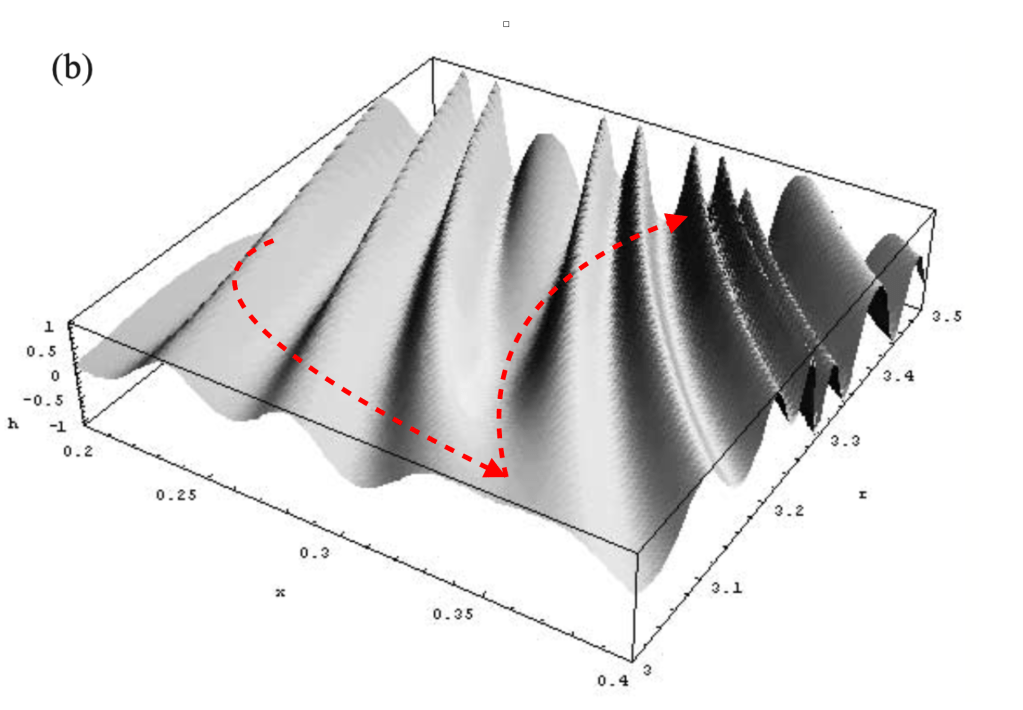
Wave terrain reprensetation of an iterated function. Traversing the map – for instance following the the red path – results in a specific sound outcome.
In what ways can the principles of non-standard synthesis help reframe computer music education to make it more adventurous, intriguing, and inclusive? How can this heritage be re-actualized on contemporary technologies and made resilient against rapid technological obsolescence?
There is a need to introduce students to the mathematical and logical foundations of sound synthesis and signal processing in ways that are both accessible and artistically meaningful. While these foundations are essential for a deep understanding of computer music, two challenges persist: (a) Sonology students enter the programme with highly diverse backgrounds and varying degrees of technical preparation; and (b) the mathematical frameworks traditionally used in digital signal processing originate in an engineering tradition. Although effective for designing scientifically robust technologies, this tradition often prioritizes audio fidelity and “correctness” according to commercial standards—criteria that do not always align with the aims of experimental or exploratory artistic creation.
Other Research Questions
In computer music, the “heretic” approaches of the past often become the commercially available products of the present. How, then, can we reframe the dichotomy of standard versus non-standard sound synthesis in the 21st century? In what sense does this distinction remain urgent?
What strategies—such as open-source development, academic engagement, and knowledge sharing—can ensure that these approaches remain alive, accessible, and unconstrained?
References
[1] Berg, P., Rowe, R., & Theriault, D. (1980). SSP and Sound Description. Computer Music Journal, 4(1), 25–35. https://doi.org/10.2307/3679439
[2] Berg, P. (1979). PILE: A Language for Sound Synthesis. Computer Music Journal, 3(1), 30–41.
[3] Serra, M.-H. (1993). Stochastic Composition and Stochastic Timbre: GENDY3 by Iannis Xenakis. Perspectives of New Music, 31(1), 236–257. https://doi.org/10.2307/833052
[4] Blum, T. 1979. “Review of ‘Herbert Brün: Project SAWDUST’”. Computer Music Journal 3(1): 6-7
[5] Valsamakis, N. (2013). Non-Standard Sound Synthesis with Dynamic Models. PhD Dissertation.
[6] Döbereiner, Luc. “Models of Constructed Sound: Nonstandard Synthesis as an Aesthetic Perspective.” Computer Music Journal 35, no. 3 (2011): 28–39.
[7] Di Scipio, Agostino. (2010). The Synthesis of Environmental Sound Textures by Iterated Nonlinear Functions, and its Ecological Relevance to Perceptual Modeling. Journal of New Music Research. June 2002. 109-117.
[8] Gunnarsson, B. and Brito, D. (2021). Project 2 – Implementation.https://www.researchcatalogue.net/view/1081939/1081944
 Riccardo Marogna